


OpenAI API
openai.com
GPT models billed per token.
Official site
This link pays this site nothing today. It goes to openai.com.
- 18 published
- 0 not published
- 0 given two ways
For a freelancer about to paste a client's data into an AI tool and wondering what the contract needs to say. You get each provider's account set to the right tier and storage settings, and a one-page data note quoting the training and retention terms, before the first paste.
A client-safe account at each provider, on the right tier, model and storage settings, plus a one-page data note quoting the training and retention terms for the client contract.
Before a client's spreadsheet, transcript or customer list goes into a model, there is an hour of setup and a page to write, and that page is the thing a client's lawyer asks for before signing. Every provider answers the first question in one sentence; the whole rest of the work is the switches that keep each sentence true.
| Provider | The training sentence, from its own page | The switch that keeps it true | What is kept, and for how long |
|---|---|---|---|
| OpenAI | Data sent to the API is not used to train its models unless you opt in, since March 1, 2023 | Use /v1/responses or /v1/chat/completions, not conversations or threads | Abuse-monitoring logs, up to 30 days, unless Zero Data Retention is approved |
| Anthropic | Retained data is never used for model training without your express permission | A model that is not a Covered Model; stay off the Console for client text | Inputs and outputs deleted within 30 days; Covered Models require 30-day retention |
| Gemini | Free tier content is used to improve Google's products; Paid tier content is not | Link billing, so the project moves to Tier 1 | Opt-in logs, 55 days by default, adjustable to 7; never share a dataset |
| Mistral | No training except on opt-in products, Feedback, an Order Form, or Labs and Preview | Record each product's preference; keep client work off Labs and Preview | A licence to use data to provide and optimize the products, excluding training |
Three of the four cost nothing on their default settings. The hour is not spent on money; it is spent on the note, and the note is what lets you take the job.
The path above walks every step. What follows is the reasoning behind each and the numbers you quote from.
The client has read that AI tools train on what you paste, and their contract with their own customers says the data goes nowhere. They do not want a reassurance; they want the sentence, the source and the date. A freelancer who hands them that page before they ask is the one who gets the transcript to work on.
Every figure below is read from the platform profile it belongs to, not written into this page. Follow a name to see every answer we have for that platform.
One paragraph per provider you will use, quoting the training sentence. OpenAI: data sent to the API is not used to train unless you opt in, since March 1, 2023. Anthropic: retained data is never used for training without express permission, and it may not train on Customer Content. Gemini: the Paid tier does not use your content to improve Google's products; the Free tier does. Mistral: not, except opt-in, Feedback, an Order Form, or Labs and Preview Models. This paragraph goes into the client contract.
Responses and chat completions keep no application state by default, but abuse-monitoring logs holding prompts and responses are generated for all usage and kept up to 30 days. Conversations, conversation items and ChatKit threads are retained until you delete them and are not eligible for zero retention; assistants and threads keep state until deleted. For client work stay on responses or chat completions, and if the organization is approved for Zero Data Retention the store parameter is forced to false and a Data Retention tab appears under Settings, Organization, Data controls.
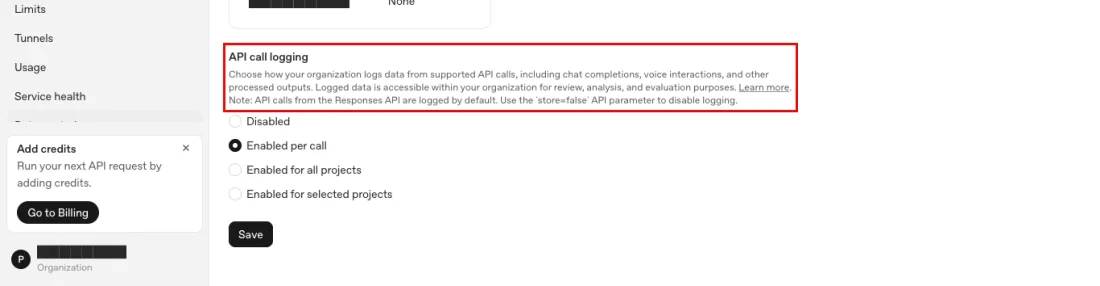
API call logging. Settings, Organization, Data controls, Data retention tab: the API call logging block with the store=false note and four options, OpenAI API, screenshot taken 2026-09-16. Account details are masked.
Conversation content is not retained by default. Four models are the exception: Claude Fable 5.1, Mythos 5.1, Fable 5 and Mythos 5 require 30-day retention and are not available under zero data retention unless expressly authorized. Zero data retention is requested from sales and enabled per organization, and it never covers usage in the Console or its playground, so a client's document pasted into the Workbench is outside it.
Set up billing in AI Studio so the project moves to Tier 1; that is the switch that stops content being used to improve Google's products. Then open Logs and Datasets: logging is opt-in and only exists on the paid tier, generateContent does not store requests by default while the Interactions API does, retention defaults to 55 days and can be set to 7, 14, 28 or 55, and a dataset shared with Google falls under the Unpaid Services terms and may train its models. Do not share one that holds client material.
The commercial terms describe two kinds of product, set to opt-out by default or to opt-in by default, and say Mistral will not train on Customer Data except where you opted in on the first kind or did not opt out on the second. They also say Labs and Preview Models may be used for training regardless of any opt-out, including zero data retention. Check the preference for each product you use in your organization's settings, and treat Labs and Preview as public.
A Professional Voice Clone stays only in your account unless you share it, and commercial use of generated content depends on you holding the rights to it. A client's recorded voice is client data with a face; the cloning consent belongs in the same data note.
OpenAI's Zero Data Retention and Modified Abuse Monitoring need prior approval and acceptance of additional requirements, and some endpoints and capabilities stay ineligible. Anthropic's is an agreement per organization, excludes the Console, Managed Agents and consumer plans, and does not support CORS, so a browser app must call through your own backend. Neither is a checkbox you can tick this afternoon.
OpenAI deletes all Customer Content within thirty days of termination and hands nothing back. Anthropic deletes API inputs and outputs within 30 days of receipt except under services with longer retention under your control, such as the Files API. The copy you keep for the client is the only copy.
OpenAI may limit or suspend access without prior notice where necessary. Anthropic may suspend all access over a suspected Usage Policy breach and disclaims liability for the loss. ElevenLabs suspends or terminates for conduct such as fraudulent transactions. A suspended account is one whose data you can no longer reach or delete on the client's schedule.
Finish with two files: the data note, one page, provider by provider, dated; and a folder of screenshots of each setting as you left it, with the date. When the client asks in six months, or the provider changes a page, you can show what was true when the work was done.
/v1/chat/completions and /v1/responses: no training, abuse-monitoring retention of 30 days, no application state except listed exceptions, eligible for Zero Data Retention. /v1/conversations, /v1/conversations/items and /v1/chatkit/threads: retained until deleted, not eligible. /v1/agents, /v1/assistants and /v1/threads: application state until deleted, not eligible.store parameter is always treated as false. Write the 30 days into the note.store false); the Interactions API does (store true); both can be set per request or per project.Earns.io (2026). Four Providers, Four Training Sentences, Four Switches. The One-Page Data Note That Lets You Take the Client's Transcript. Figures checked 2026-09-14. Retrieved from https://earns.io/en/methods/where-your-clients-data-goes
https://earns.io/en/methods/where-your-clients-data-goes
openai.com
GPT models billed per token.
This link pays this site nothing today. It goes to openai.com.
anthropic.com
Claude models billed per token. Production capacity you rent by the word.
This link pays this site nothing today. It goes to anthropic.com.
ai.google.dev
Google's model API with a free tier whose prompts are used to improve Google's products; paid usage is per million tokens and stays private.
This link pays this site nothing today. It goes to ai.google.dev.
mistral.ai
European model maker with a per-token API and open-weight models you can self-host under Apache 2.0 for research and individual use.
This link pays this site nothing today. It goes to mistral.ai.
elevenlabs.io
Voice and audio generation on a credit subscription; the free plan carries no commercial license, and a shared voice clone can earn Voice Actor Payouts.
This link pays this site nothing today. It goes to elevenlabs.io.