

Anthropic API
anthropic.com
Claude models billed per token. Production capacity you rent by the word.
Official site
This link pays this site nothing today. It goes to anthropic.com.
- 14 published
- 1 not published
- 0 given two ways
For a writer or agency quoting AI-assisted articles who does not know what to charge. You get a quote sheet for one article: the tokens, the cost of seven passes, the editing hours at a human rate, and a price that stays above all of it.
A quote sheet for one article: the job in tokens on the right tokenizer, the cost of one pass and of seven, the editing hours at a published human rate, and the price you quote, with every prompt and draft saved in your own folder.
FIG 1$LOG SCALE
Output is what you pay for an article. Input is what you pay for the brief, and it is cheaper on every model here.
FIG 2$LOG SCALE
Model rows are calculated from the published rates above: 60,400 input and 16,800 output tokens on Haiku 4.5, which is on the older tokenizer, and 78,520 input and 21,840 output tokens on the three models that are not. The working is shown in the body of this page. The last row is a published human rate for the same 1,500 words, not a calculation. The two OpenAI models are absent because no published source converts this article into their tokens.
The question has a small answer and a large one, and a quote that uses only the small one is wrong. The small answer is the token bill for one 1,500-word article through seven drafts. The large answer is the hours you spend beside the model, at a rate a professional body actually publishes. Both belong on the sheet, and the gap between them is the whole business.
| One 1,500-word article | |
|---|---|
| Seven passes on Claude Haiku 4.5 | $0.14 |
| Seven passes on Claude Sonnet 5 | $0.38 |
| Seven passes on Claude Opus 5 | $0.94 |
| Seven passes on Claude Fable 5.1 | $1.88 |
| A writer at the lowest published blog rate, 25.0 cents a word | $375 |
| Editing business copy, per the same chart | $45.00 to $75.00 an hour |
The most expensive token bill on the page is a two-hundredth of the cheapest human rate. The client is not paying for tokens; they are paying for the hours you spend checking, and the token line goes on the quote precisely so they can see how small it is.
The path above walks every step. What follows is the reasoning behind each and the numbers you quote from.
The client has heard that AI writes articles for free and wants to know why yours costs $375. The answer on the sheet is the seven passes at $0.14 to $1.88, and then the hours: the fact pass against their sources, the tone pass against their previous pieces, the line edit. A quote that shows both lines answers the question before it is asked, and a quote that hides the token line invites it.
Every figure below is read from the platform profile it belongs to, not written into this page. Follow a name to see every answer we have for that platform.
Anthropic publishes two estimates: a token is approximately 3.5 English characters on its token-counting page, and approximately 4 characters or 0.75 words on its pricing page. Either way a 1,500-word article is about 2,000 output tokens plus the brief. OpenAI's pricing page publishes no character-per-token ratio at all, so for gpt models the first pass is the measurement.
Claude 4.7 and later models use a newer tokenizer that produces approximately 30% more tokens for the same text; Claude Sonnet 4.6 and earlier use the previous one. The same article is 2,000 tokens on one and about 2,600 on the other, and every price below moves with it.
Send the real brief and read input_tokens and output_tokens in the response; that replaces both estimates with a measurement. Then price it: Haiku 4.5 at $1 per million input and $5 per million output, Sonnet 5 at $2 and $10, Opus 5 at $5 and $25, Fable 5.1 at $10 and $50; gpt-4o-mini at $0.15 and $0.60, gpt-5 at $1.25 and $10.00. One pass of 2,000 output tokens is a cent on Haiku 4.5 and ten cents on Fable 5.1.
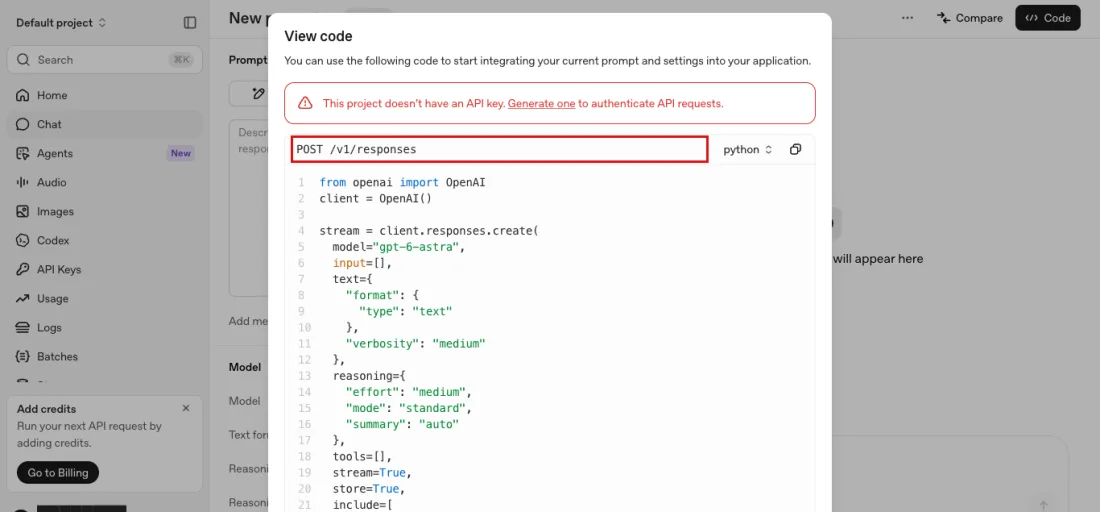
POST /v1/responses. View code panel of the Chat playground, the Python request with store=True on line 20, OpenAI API, screenshot taken 2026-09-16. Account details are masked.
A real article is an outline, a draft, two rewrites, a fact pass, a tone pass and a final: seven passes. The chart above prices exactly that: $0.14 on Haiku 4.5, $0.38 on Sonnet 5, $0.94 on Opus 5, $1.88 on Fable 5.1. Anthropic's pricing page offers 50% off with batch processing, and OpenAI's batch rows for gpt-5 are $0.625 and $5.00, for anything that can wait until tomorrow.
The Editorial Freelancers Association's 2026 chart puts work-for-hire blog posts at 25.0 to 45.0 cents a word or $74.50 to $87.50 an hour, ghostwriting for articles at 15.0 to 30.0 cents a word or $75.00 to $100.00 an hour, and editing business copy at $45.00 to $75.00 an hour by depth. A 1,500-word article at the lowest blog rate is $375. The quote is the token line plus your hours at a rate from that chart; the chart is why the token line does not matter.
Anthropic auto-deletes API inputs and outputs within 30 days. OpenAI deletes all Customer Content within thirty days of termination and hands nothing back. The seven drafts and the brief go into a folder with the client's name on it the day they are made.
Anthropic may suspend all access over a suspected Usage Policy breach and disclaims liability for the loss; OpenAI may limit or suspend access on a breach, without prior notice where necessary. A content schedule built on one key needs the second key in the same folder.
Earns.io (2026). Seven AI Drafts of a 1,500-Word Article Cost $0.14 to $1.88. The Writer's Rate for the Same Article Is $375. Figures checked 2026-09-14. Retrieved from https://earns.io/en/methods/what-an-ai-written-article-costs
https://earns.io/en/methods/what-an-ai-written-article-costs
anthropic.com
Claude models billed per token. Production capacity you rent by the word.
This link pays this site nothing today. It goes to anthropic.com.
openai.com
GPT models billed per token.
This link pays this site nothing today. It goes to openai.com.