Forty Customer Questions a Week Cost About a Dollar per Thousand Answers. A Support Bot Built From Your Own Policy Pages
What this is for
For a one-person shop answering the same shipping and returns questions every day. You end up with a bot that answers them from your own policy pages for about a dollar per thousand answers, and a spend cap so a bad week cannot run up the bill.
What you make
A bot that answers customers from your own shipping, returns and sizing pages: first a desk assistant you paste messages into, then on the site if you have a server.
A one-person shop gets the same forty questions a week: where is my order, do you ship to Ireland, can I return this, does it run small. Each one costs a few minutes and a little goodwill when it waits until evening. A bot that answers them from your own policy pages costs about a dollar per thousand answers, and the two numbers that decide whether it is still answering at the end of a busy month are printed on each provider's page.
One exchange: a 300-token question, 5,000 tokens of policy, a 200-token answer
Per thousand exchanges
gpt-4o-mini, policies in the prompt, $0.15 in and $0.60 out
about $1
gpt-4o-mini with file search instead
a smaller prompt plus $2.50 per thousand tool calls
Claude Haiku 4.5, policies uncached, $1 in and $5 out
about $6
Claude Haiku 4.5, policies cached at $0.10 per million
under $2
The ceiling above the price
$100 a month on OpenAI's Free tier and Tier 1; $500 on Anthropic's Start tier; $250 on Gemini's Tier 1
The value is not the dollar saved; it is the forty replies that go out in your shop's words while you pack orders. The play is a desk assistant first, an afternoon in a browser with no code, and a widget on the site only if someone can host a small server.
The play, in three lines
Write the shipping, returns, sizing and payment pages as short plain files, one per topic, before you open any console.
Paste them into Google AI Studio's System Instructions with one line above, answer only from these pages, link a billing account, and play the customer with your ten commonest questions until eight come back right.
When it is right, turn the same prompt into one API call with the files attached, size one exchange, write the 429 fallback message, and read the ceiling before the price.
The path above walks every step. What follows is the reasoning behind each and the numbers you quote from.
Where the money comes from
Nowhere, directly. This is a cost line, not an income line: about a dollar per thousand answers on the cheapest route.
The hours it returns. Forty questions a week answered from the desk assistant in seconds each, in the shop's own words, instead of forty evening emails.
The sale it keeps. A customer who asks whether you ship to Ireland at 2pm and hears yes at 2:01pm is still on the page.
The pain you are selling the cure for
The customer wants one answer, now, in plain words, from the shop itself, not a chat window that invents a returns policy. The pain on your side is the repetition and the invention: a bot that reads your policy pages and says "that is not in our policy, email us" when it does not know is the whole product. Everything in the path is there to make it say only what your pages say.
The path, step by step
Every figure below is read from the platform profile it belongs to, not written into this page. Follow a name to see every answer we have for that platform.
1
Write the knowledge base as files before you touch a model
Shipping, returns, sizing, payment, the ten questions customers actually ask: one file each, in .md, .txt, .pdf, .docx or .html, all formats OpenAI's file search accepts. Keep them short and literal; the bot answers with what is in them and nothing else. OpenAI stores the first 1 GB free; Gemini File Search stores up to 1 GB on the Free tier and 10 GB on Tier 1 at no charge, with 100 MB per document.
2
Path A, in a browser: paste the policies into System Instructions and play the customer
Open Google AI Studio, click Run settings in the top right, paste the policy files into System Instructions with one line on top (answer only from these pages; if the answer is not here, say so and offer email), and ask it the ten questions as a customer would. The quickstart's own example is a customer service bot that only talks about a company's product. This is a working desk assistant in an afternoon: paste the customer's message, copy the answer, send.
3
Path B, the API: one call with the files attached
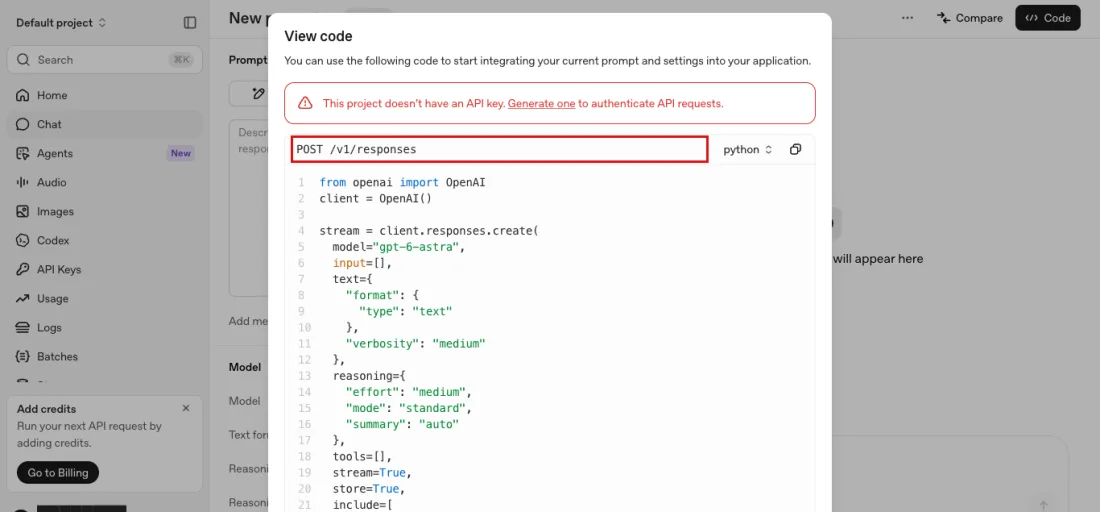
OpenAI: upload the files, create a vector store, add them, wait for status completed, then send the customer's message to the Responses API with the file_search tool and the store id; the reply comes back with citations. Anthropic: put the policy text in the system prompt with a cache_control block; the cache lives 5 minutes, refreshes free on every use, and reads cost a tenth of base input. Gemini: create a File Search store, upload, and pass it as a tool; storage and query embeddings are free.
Outlined in red: POST /v1/responses. View code panel of the Chat playground, the Python request with store=True on line 20, OpenAI API, screenshot taken 2026-09-16. Account details are masked.
Anthropic APINo renewal fee, only per-token spend. Sonnet 5 holds at $2/MTok input and $10/MTok output after the scheduled rise to $3/$15 was cancelled.source · checked 2026-09-07
GMGemini APIPer 1M tokens in USD on the Paid tier: Gemini 3.8 Flash $0.75 input and $3.75 output through December 31, 2026, rising to $1.50 and $7.50 from January 1, 2027; Gemini 2.5 Flash $0.30 input, Flash-Lite $0.10, Gemini 2.5 Pro $1.25 input; Batch cuts the cost 50%source · checked 2026-09-12
4
Size one exchange and multiply by the month
A customer message is about 300 tokens, your policies about 5,000, an answer about 200. On gpt-4o-mini at $0.15 in and $0.60 out per million, with the policies in the prompt, an exchange is a tenth of a cent and a thousand are about a dollar; through file search add $2.50 per thousand tool calls. On Claude Haiku 4.5 the cached policies read at $0.10 per million instead of $1, so a thousand exchanges are under two dollars instead of over six.
5
Check the minimum before you count on the cache
Anthropic's caching page prints the floor: 4,096 tokens for Claude Haiku 4.5, 1,024 for Sonnet 5, 512 for Opus 5. A 3,000-token policy set on Haiku 4.5 is processed without caching and no error is returned; the usage fields show zero cache reads. Either pad the policies past the minimum or pick the model whose floor you clear.
6
Read the ceiling before you read the price
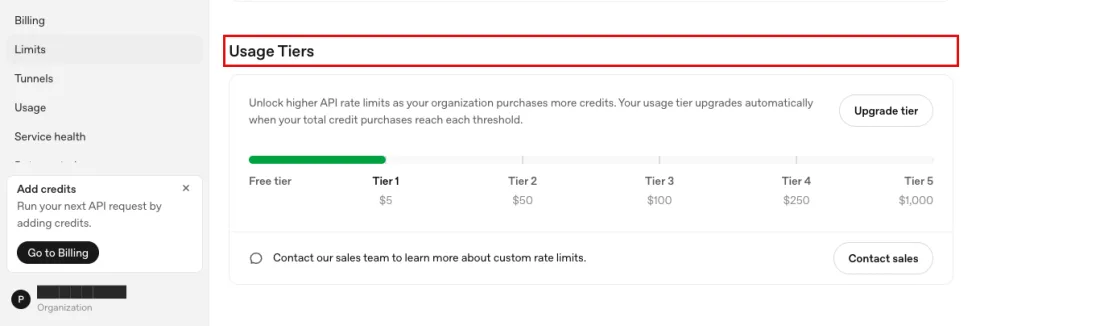
OpenAI's Free tier and Tier 1 both allow $100 of usage a month; Tier 2, at $50 paid, allows $500. Anthropic's Start tier caps at $500 a month, Build at $1,000. Gemini Tier 1 caps the account at $250 and spend at $10 per rolling 10 minutes. A thousand exchanges never touch these; a viral product page might.
OpenAI APIBilled per token from the first call, no plan fee listed: gpt-4o-mini costs $0.15 per 1M input tokens and $0.60 per 1M output tokens.source · checked 2026-09-07
Anthropic APIPrepaid credits, pay-as-you-go, no subscription. Cheapest entry rate is Haiku 4.5 at $1/MTok input and $5/MTok output; no minimum purchase is published.source · checked 2026-09-07
GMGemini APIFree of charge on the Free tier, with free input and output tokens, Google AI Studio access and limited access to certain models; the catch is that free-tier content is used to improve Google's productssource · checked 2026-09-12
7
Write the fallback message for the 429 before the first customer sees one
At Anthropic's spend cap every request returns HTTP 429 enforced_spend_limit_reached with no retry-after header until 00:00 UTC on the first of next month. At Gemini's spend limit the reply is 429 RESOURCE_EXHAUSTED on a rolling 10-minute window. Your bot must catch a 429 and answer with a plain sentence and your email address, not a blank screen.
GMGemini APIPrepaid then pay-as-you-go billing to reach the Paid tier, which brings higher rate limits, context caching, the Batch API and Google's most advanced models, and stops your content being used to improve Google's productssource · checked 2026-09-12
8
Move off the free tier before customers arrive
A customer's message is personal data. Gemini's Free tier content is used to improve Google's products and its Paid tier content is not; the upgrade to Tier 1 typically takes effect instantly once billing is set up. OpenAI's Free tier is limited to allowed geographies and $100 a month, and $5 paid moves you to Tier 1.
Outlined in red: Usage Tiers. Settings, Organization, Limits: Free tier to Tier 5 with the credit purchase that unlocks each, OpenAI API, screenshot taken 2026-09-16. Account details are masked.
GMGemini APIPrepaid then pay-as-you-go billing to reach the Paid tier, which brings higher rate limits, context caching, the Batch API and Google's most advanced models, and stops your content being used to improve Google's productssource · checked 2026-09-12
Decide where the bot lives: your desk, or a server
A bot on your website needs a server. OpenAI's ChatKit embeds a chat widget, but your own server must create each session with a unique user id and hand the client secret to the page; its no-code companion Agent Builder is scheduled to shut down on November 30, 2026, so do not build a new bot on it. Without a developer, the desk assistant from Path A answers the same questions through you.
10
Use the slow lane for anything that is not live
Summaries of the week's tickets, tagging, translations of the FAQ: OpenAI's Batch API is 50% cheaper, draws on a separate pool of higher rate limits and completes within 24 hours. Only the customer standing at the counter needs the live price.
11
Read what ends it, because the bot is a single point of failure
Anthropic may suspend all access over a suspected Usage Policy breach and disclaims liability for the loss that causes; OpenAI may limit or suspend access for a breach, without prior notice where necessary. Keep the policy files and the system prompt in your own folder so the bot can be rebuilt on the other provider in an hour.
Anthropic APIAnthropic may suspend all access over a suspected Usage Policy breach, and disclaims liability for any loss of data or profits that suspension causes.source · checked 2026-09-07
OpenAI APIOpenAI may limit or suspend access if required by law or if the customer breaches the agreement or OpenAI Policies, without prior notice where necessary.source · checked 2026-09-07
12
If the shop lives on Shopify, add the plan to the bill
Shopify Basic is $25 a month paid monthly or 19 US$ a month paid yearly. The bot's monthly bill is a rounding error next to it; the plan is the line that decides whether the shop is open at all.
ShopifyBasic at 19 US$/mo when paid yearly or $25 USD/mo paid monthly, after a free start; a custom domain bought through Shopify renews automatically each year on topsource · checked 2026-09-12
Check these five before you sign up
1Write the policies as short files first, one topic each. Everything the bot may say must be in them.
2Prototype in Google AI Studio with the policies in System Instructions and a first line that tells the model to answer only from them; ask the ten real questions before you write any code.
3Count the tokens of one real exchange, message plus policies plus answer, and multiply by the month; at gpt-4o-mini's $0.15 and $0.60 per million a thousand exchanges with policies attached is about a dollar.
4On Anthropic, check the caching floor: 4,096 tokens on Haiku 4.5, 1,024 on Sonnet 5, 512 on Opus 5. Below it the prompt is silently not cached.
5Read the ceiling of your tier, not just the price: OpenAI Free $100 a month, Tier 1 $100, Tier 2 $500, Tier 3 $1,000; Anthropic Start $500, Build $1,000; Gemini Tier 1 $250 billing cap and $10 per 10 minutes.
6Write the 429 fallback before launch, with your email in it. Anthropic's spend cap pauses usage until 00:00 UTC on the 1st; Gemini's spend limit clears on a rolling 10 minutes.
7Get off Gemini's Free tier before a customer's message goes through it; the Paid tier is the switch that stops content being used to improve Google's products.
8Do not build a new bot on OpenAI's Agent Builder; it shuts down November 30, 2026. A website widget through ChatKit needs your own server; without one, run the bot at your desk.
9Put everything that is not a live reply through OpenAI's Batch API: 50% cheaper, higher separate limits, done within 24 hours.
Step one: the policies as files
One file per topic, in plain words, covering the questions you actually get: shipping countries and times, returns and who pays postage, sizing, payment methods, order changes.
OpenAI's file search accepts .pdf, .docx, .md, .html, .txt and .json among others, with the first 1 GB of storage free and $0.10 per GB per day after. Gemini's File Search takes documents up to 100 MB each, 1 GB total on the Free tier and 10 GB on Tier 1, stored free. For a shop's policies, storage on either is zero.
Path A: in a browser, an afternoon
Google AI Studio opens the Playground with a new chat prompt. Run settings, top right, holds the System Instructions field; paste the policy files with one line above them: answer only from the pages below, in the shop's voice, and if the answer is not in them say so and offer the shop's email.
Be the customer. Type the ten questions you get most, the way customers type them, and read the answers against the pages. Where it invents, tighten the line; where it is right but cold, add a sentence about tone. The quickstart's own example is exactly this shape, a customer service chatbot that only talks about a company's product.
The result is a desk assistant: paste the customer's message, copy the answer, send it from your own inbox. For forty questions a week that is most of the value of a bot, with no code and no server. Get code turns the same prompt into the API call for Path B.
Before any real customer message goes through it: Free tier content is used to improve Google's products, Paid tier content is not, and linking a billing account moves the project to Tier 1 typically instantly. Link it first.
Path B: one call, with the files attached
OpenAI, the file search tool in the Responses API: upload each file, create a vector store, add the files, poll until each file's status is completed, then send the customer's message with the file_search tool and the vector store id in the tools list. The response holds a file_search_call item and a message with file citations. Beyond tokens: $2.50 per thousand tool calls, and the storage above.
Anthropic, prompt caching: put the policy text in the system prompt and mark it with a cache_control block of type ephemeral. The cache lives 5 minutes, refreshed at no cost each time it is used; a 1-hour cache costs extra. On Claude Haiku 4.5, base input $1 per million tokens, writing the cache $1.25, reading it $0.10; Sonnet 5 $2, $2.50, $0.20; Opus 5 $5, $6.25, $0.50. Your 5,000 tokens of policy are read at a tenth of the price on every exchange after the first.
Gemini, File Search: create a store, upload the files, pass the store as a tool on each request. Storage and query-time embeddings are free; you pay for embeddings once at indexing and for retrieved document tokens as regular context. It cannot be combined with Google Search grounding in the same request.
One exchange, then the month
The table above is one exchange multiplied by a thousand. The AI job cost calculator has the token prices for every model on this page.
The line that trips people: Anthropic's minimum cacheable prompt length is 4,096 tokens for Haiku 4.5, 1,024 for Sonnet 5, 512 for Opus 5. A 3,000-token policy set on Haiku 4.5 is processed without caching and no error is returned; the only sign is cache_creation_input_tokens and cache_read_input_tokens both reading zero. Pad short policies past the floor with the FAQ, or pick the model whose floor you clear.
FIG 1LOG SCALE
OpenAI API usage limit per month, by tier
The ceiling a new account can spend in a month, as published, against the payment that unlocks each tier. Log scale, because the top tier is two thousand times the bottom one.
The chart above is OpenAI's usage tiers: Free, for users in an allowed geography, $100 of usage a month; Tier 1 at $5 paid, also $100; Tier 2 at $50 paid, $500; Tier 3 at $100 paid, $1,000; Tier 4 at $250 paid, $5,000; Tier 5 at $1,000 paid, $200,000. Underneath sit rate limits in requests and tokens per minute and per day, hit on whichever comes first; file search has its own, 100 requests a minute on Tier 1.
Anthropic's spend caps: $500 a month on Start, $1,000 on Build, $200,000 on Scale, with a token bucket that may enforce 60 requests a minute as one a second, per model.
Gemini's Tier 1 needs a linked billing account, caps the account at $250 and spend at $10 per rolling 10 minutes; Tier 2 needs $100 paid plus 3 days and caps at $2,000.
None of this touches a thousand exchanges. A product that goes viral on a Saturday can touch all of it.
Write the fallback before the cap
Anthropic: once the spend cap is reached, API usage pauses until 00:00 UTC on the first day of the next month unless a higher limit is requested; every request returns HTTP 429 with enforced_spend_limit_reached and no retry-after header, so retries fail until access resumes.
Gemini: 429 RESOURCE_EXHAUSTED, clearing on its rolling 10-minute window.
The bot's code, or your desk routine, treats a 429 as a message, not a crash: one plain sentence, the shop's email, and a note to you.
Anything that is not a live reply, the week's ticket summary, tagging, translating the FAQ, goes through OpenAI's Batch API: 50% cheaper, a separate pool of higher limits, done within 24 hours, never competing with the customer at the counter.
Where the bot lives
A bot on the website needs a server between the page and the provider, because the key cannot sit in the page.
OpenAI's ChatKit is the embeddable chat for that; your server creates a ChatKit session with a unique user identifier for each end user and hands the client secret to the widget. Its no-code companion, Agent Builder, is being deprecated and is scheduled to shut down on November 30, 2026.
The honest options are two: a developer who hosts a small server, or the desk assistant from Path A. For forty questions a week, the second is often the right size.
What ends it
Anthropic may suspend all access over a suspected Usage Policy breach and disclaims liability for the loss that causes. OpenAI may limit or suspend access for a breach, without prior notice where necessary.
The defence is the folder from step one: the policy files and the system prompt are yours, rebuildable on another provider in an hour. The data page reads what each provider keeps of the conversations.
If the shop lives on Shopify, the plan is $25 a month paid monthly or 19 US$ a month paid yearly, and the bot's dollar sits under it.
What to do today
Write the shipping and returns pages as two short files.
Paste them into Google AI Studio's System Instructions with the answer-only-from-these line, link a billing account, and ask it your ten questions.
Eight right: you have a desk assistant before dinner. The drafting page turns the same system prompt into one API call.
Write down the caching floor and the 429 fallback before it ever talks to a customer unsupervised.
Earns.io (2026). Forty Customer Questions a Week Cost About a Dollar per Thousand Answers. A Support Bot Built From Your Own Policy Pages. Figures checked 2026-09-14. Retrieved from https://earns.io/en/methods/a-support-bot-for-a-one-person-shop