Twenty Product Images Cost $0.06 to $0.80 and a 30-Second Clip $1.50 to $9. The Hour You Spend on One Reference Image Is the Real Cost
What this is for
For a shop owner or freelancer who needs listing images and a short clip without a photographer. You get twenty images and a 30-second clip from one reference photo, reproducible from the seeds you wrote down, for cents on the images and a few dollars on the clip.
What you make
Twenty product images in the listing's ratios and a 30-second clip, all from one approved reference image, with the seeds written down so the look can be reproduced.
A shop owner wants a listing dressed: twenty pictures of one product in the ratios the marketplace wants, and a thirty-second clip for the top of the page. A photographer is a day and a studio. From one approved reference image, the hosts' own price pages make the whole set for under ten dollars.
The job
Cheapest published rate
Dearest published rate
Twenty product images
$0.06 on Replicate flux-schnell, $3.00 per thousand
$0.80 on Replicate flux-1.1-pro, $0.04 an image
Thirty seconds of video, as three 10-second clips
$1.50 on fal Wan 2.5, $0.05 a second
$9.00 on OpenAI sora-2-pro at 720p, $0.30 a second
The whole listing
under $2
under $10
The host bill is not the cost. The hour you spend getting one reference image approved and writing down its seed is, and that hour is what makes the next product in the line take half as long. Everything below is how to spend it once.
The play, in three lines
Get one picture approved, a photograph or a first generation the client says yes to, and write down its seed and prompt.
In Replicate's FLUX 1.1 pro playground, make the twenty from that seed, changing only the prompt and the ratio; in fal's Wan 2.5 playground, animate three of them into 10-second clips and join them.
Save every file the same hour, put the seeds in your notes, and read the two licences on every image before it goes on a product page.
The path above walks every click. What follows is the reasoning behind each step and the numbers you quote from.
Where the money comes from
A shop owner with a listing to dress. They pay for twenty files in the right ratios and a clip, all recognisably the same object, delivered this week.
A print-on-demand margin, if the pictures sell a product you make. Then the eighty cents of images is the smallest line on the sheet, and Printify's base price, shipping and the marketplace's cut are the numbers that matter; the POD pages carry them.
Not the host. fal sells prepaid credits and charges only for successful outputs; Replicate bills most models by run time, in arrears; OpenAI bills per second of video.
The pain you are selling the cure for
The listing needs one product on white, in a hand, on a table, in the room it belongs in, at 1:1 for the grid, 4:5 for the page and 16:9 for the banner, and every one must be the same mug. Twenty prompts give twenty mugs. One approved image with its seed written down gives one mug twenty times, and that consistency is the whole thing the client is paying for.
The path, step by step
Every figure below is read from the platform profile it belongs to, not written into this page. Follow a name to see every answer we have for that platform.
1
Start from one approved reference image, not from twenty prompts
Get one hero shot the client signs off on first. On Replicate, FLUX 1.1 pro takes an image_prompt alongside the text prompt to guide the composition of every later image toward it. On fal, Wan 2.5 uses an image as the first frame of the video. One approved picture is the anchor for the other nineteen and for the clip.
2
Path A, in the browser: the model's Playground tab
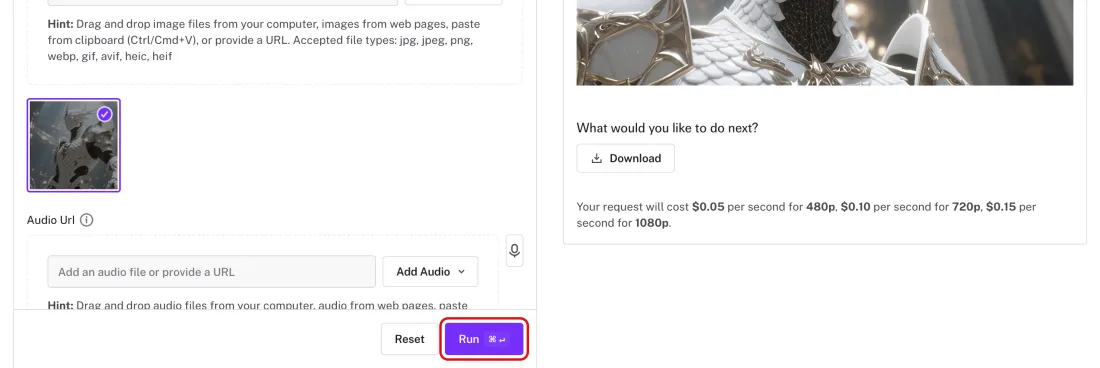
Every model on Replicate has a playground page with a web form: type the prompt, choose aspect_ratio (1:1 for the grid, 4:5 for the listing, 16:9 for the banner), set output_format to png or jpg instead of the default webp, click Run and download. On fal, the model page's Playground tab is the same form generated from the schema, with an upload box for the image; the Sandbox shows the estimated cost before you submit.
Outlined in red: Run. Model page, Playground tab of an image-to-video model: the reference image slot, the Run button and the per-second price for each resolution shown before you submit, fal.ai, screenshot taken 2026-09-16. Account details are masked.
3
Twenty images: fix the seed, change the prompt and the ratio
FLUX 1.1 pro's seed input is described as set for reproducible generation. Write down the seed of the image the client approved. Then run the variations you need for the listing, the same product on a white background, in use, in a room, at each ratio the shop wants, keeping output_quality at its default of 80 or raising it to 100 for the hero. Twenty runs of the form is twenty images.
4
Thirty seconds of video is three 10-second clips
Wan 2.5 image-to-video on fal generates 5 or 10 seconds per run, at 480p, 720p or 1080p, from a first-frame image of at most 10MB and 360 to 2000 pixels a side, in JPEG, PNG without alpha, BMP or WEBP, with a motion prompt of up to 1500 characters. Each run takes 1 to 3 minutes. Three 10-second clips from three of your approved images, joined in any video editor, is the 30-second listing clip.
5
Path B, the API, when it is twenty listings and not one
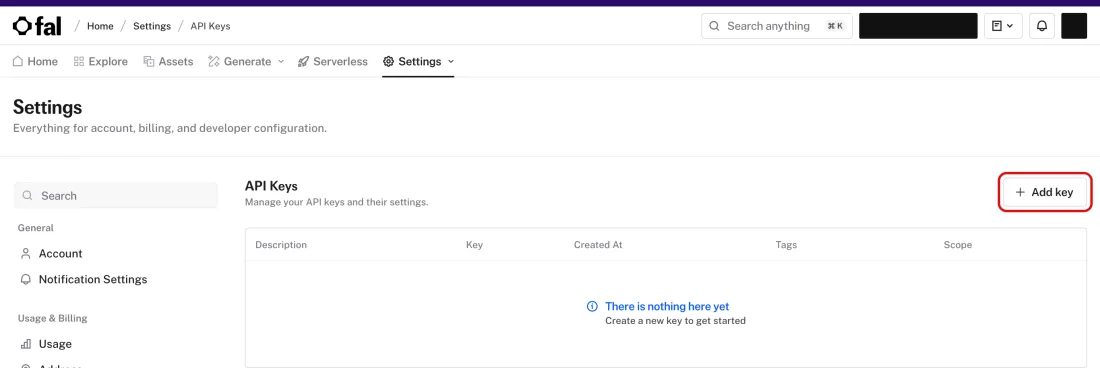
Every fal Playground result comes with Python, JavaScript and cURL code that reproduces the exact request; copy it. Replicate's Python client runs a model in a few lines and returns file objects you save to disk. The web form is where you find the prompt and settings; the API is where you repeat them two hundred times.
Outlined in red: Add key. Settings, API Keys: the empty list and the button that makes the key every API call carries, fal.ai, screenshot taken 2026-09-16. Account details are masked.
6
Save the files the same hour
For predictions created through Replicate's API, all inputs, outputs, output files and logs are removed after an hour by default. Predictions made in the web interface are kept indefinitely. Whichever route made the images, the copy on your disk is the deliverable.
7
Read the per-unit price, then multiply by the batch
Replicate prints $0.04 per image on flux-1.1-pro, $0.025 on flux-dev and $3.00 per thousand on flux-schnell, so twenty images are $0.80, $0.50 or $0.06. Video is per second: fal Wan 2.5 $0.05, Replicate wan-2.1 $0.09, OpenAI sora-2 $0.10 and sora-2-pro $0.30 at 720p, so thirty seconds is $1.50, $2.70, $3.00 or $9.00.
ReplicatePer use, with no monthly plan: $0.04 per output image on flux-1.1-pro, $0.025 on flux-dev, $3.00 per thousand images on flux-schnell, $3.75 per million input tokens on deepseek-r1, $0.09 per second of output video on wan-2.1-i2v-480psource · checked 2026-09-11
fal.aiPer output, varying by model: video models such as Wan 2.5 at $0.05 per second of output, image models per image or per megapixel, and your own deployments on GPUs from $1.89/hr for an H100source · checked 2026-09-12
Check who owns the output, and whose licence the model carries
The host's terms give you your Input at fal and Your Content and Output at Together; both point at the model's own third-party terms, and Replicate's FLUX page says using it means agreeing to Black Forest Labs' API agreement. The host's page is one licence; the model's is the second, and a product page needs both.
fal.aiCustomer owns and retains all right, title and interest in the Customer Input, subject to a license letting fal process it to provide the Services; fal keeps ownership of the Services, models and technologysource · checked 2026-09-12
Together AIAs between you and the Company, you exclusively own all right, title and interest in Your Content and Output, granting Together only a limited license to host and operate them as necessary to provide the Services; the models themselves may carry their own third-party termssource · checked 2026-09-12
9
Read how billing can surprise you
Replicate bills in arrears and can charge early the first time usage crosses certain limits, as a fraud check. Together's credits by ACH or wire are not usable until the payment clears, and access can be suspended if any amount is 5 days past due.
ReplicateBilling must be set up: accounts billed in arrears are charged at the beginning of the month for the previous month's usage, and can be charged early the first time usage crosses certain limits, as a fraud checksource · checked 2026-09-11
Together AIPay as you go, with fees that are non-refundable; credits funded by ACH or wire are not usable until the payment clears, and access can be suspended on notice if any amount is 5 days past duesource · checked 2026-09-12
10
Read what expires and what can vanish
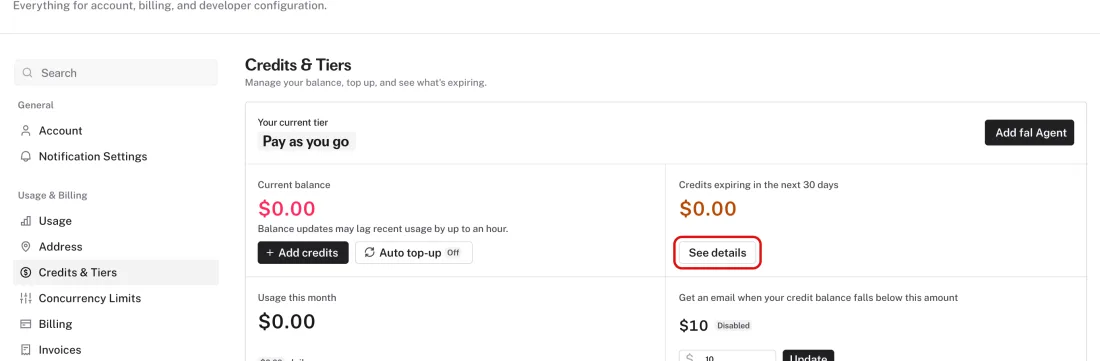
fal credits expire 365 days from purchase, promotional credits in 90 days, and an account idle for more than a year can be deactivated. Replicate may suspend or disable access to a Marketplace Model at any time for any reason. Keep a second model tested for every product line.
Outlined in red: See details. Settings, Credits and Tiers: current tier, balance and the box that counts credits expiring in the next 30 days, fal.ai, screenshot taken 2026-09-16. Account details are masked.
fal.aiCredits expire 365 days from purchase, promotional credits in 90 days, and are non-refundable and non-transferable; fal may deactivate an account that does not log in or use the Services for more than one year, and may suspend access over Customer Input it deems likely to violate the law or the Termssource · checked 2026-09-12
ReplicateReplicate may suspend, terminate or deny access to all or part of the Services on a governmental demand or order among other grounds, and may suspend or disable access to a Marketplace Model at any time for any reason, with no liability for the changesource · checked 2026-09-11
Together AITogether may suspend access or terminate the Agreement if it determines you breached it, needs to prevent a credible risk of harm or liability, or is required by law, taking reasonable steps to give written notice first; you may not terminate without its written consentsource · checked 2026-09-12
11
If the images sell a print-on-demand product, add the product cost to the same sheet
The image bill is cents; the mug the image sells has a base price, a shipping price and a marketplace cut. The POD pages on this site carry those figures, and the twenty images belong on the same sheet as the product cost.
1Get one reference image approved before you generate twenty. On Replicate FLUX 1.1 pro, pass it as image_prompt; on fal Wan 2.5, it is the first frame.
2Set output_format to png or jpg in the form; the default is webp, which some shop uploaders will not take.
3Write down the seed of every image the client approves. FLUX 1.1 pro's seed makes a generation reproducible; without it you cannot make the same picture twice.
4Plan video in 5 or 10 second pieces: Wan 2.5 makes one piece per run, 1 to 3 minutes each, from an image under 10MB with no alpha channel. Thirty seconds is three runs and a join.
5Download every API output inside the hour. Replicate removes API inputs, outputs and files after an hour by default; web-interface predictions are kept.
6Price by the provider's unit: per image (Replicate flux models), per second (fal Wan 2.5, Replicate wan-2.1, OpenAI sora-2), or per thousand images (flux-schnell at $3.00).
7Check the model's own licence as well as the host's terms; Replicate's FLUX page binds you to Black Forest Labs' API agreement, and Together and fal both point to the model's third-party terms.
8Spend fal credits inside 365 days and promotional credits inside 90, expect Replicate's first invoice early, and keep a second model ready in case a Marketplace Model is disabled.
Step one: the reference image
Start with one picture the client approves, a real photograph or a first generation iterated until yes.
Replicate's FLUX 1.1 pro form has an image_prompt input, an image used together with the text prompt to guide the composition. fal's Wan 2.5 image-to-video takes an image as the first frame.
One approved picture anchors everything else on this page.
Path A: the Playground tab
Every Replicate model has a playground page with a web form. Open black-forest-labs/flux-1.1-pro: prompt; aspect_ratio from 1:1, 16:9, 3:2, 2:3, 4:5, 5:4, 9:16, 3:4, 4:3, or custom with width and height 256 to 1440 in multiples of 32; output_format webp by default, or jpg or png; output_quality 0 to 100, default 80; seed; safety_tolerance 1 to 6, default 2; prompt_upsampling, off by default.
Set the format to png or jpg; some shop uploaders will not take webp. Run, wait, download. Web-interface predictions are kept indefinitely on your dashboard, with a Delete button.
fal's model pages have a Playground tab generated from the input schema, with required fields marked, an upload box, a Run button, and each result kept on screen for comparison; the API tab shows the schemas, the page shows the price and the average latency. fal's Sandbox runs one prompt through several models side by side and shows the estimated cost before you submit.
Twenty images from one approved seed
The schema line that makes a series possible: seed, set for reproducible generation. Write down the approved image's seed and prompt.
Then the listing: the same product on a plain background, in a hand, on a table, in its room, at each ratio the marketplace wants. output_quality at 80 for the grid, 100 for the hero.
Twenty runs of the form is an afternoon, which is why the API route exists.
Thirty seconds is three clips
fal's Wan 2.5 image-to-video generates 5 or 10 seconds per run at 480p, 720p or 1080p, default 1080p. The first frame must be JPEG, JPG, PNG without alpha, BMP or WEBP, 360 to 2000 pixels a side, at most 10MB. Motion prompt up to 1500 characters; processing 1 to 3 minutes, longer for 10 seconds.
Three 10-second runs from three approved stills, joined in any video editor with a cut or a crossfade. The page carries a Commercial use badge; the licence section below says why to read it anyway.
Path B: the API, for the twentieth listing
import fal_client
result = fal_client.subscribe("fal-ai/nano-banana-2", arguments={"prompt": "a futuristic cityscape at sunset", "aspect_ratio": "16:9"})
print(result["images"][0]["url"])
Every fal Playground result includes generated code that reproduces the exact request, in Python, JavaScript and cURL. Swap the model id and arguments for the ones on your Wan or FLUX page.
Replicate's equivalent is replicate.run("black-forest-labs/flux-schnell", input={"prompt": "A majestic lion"}), returning file objects you write to disk. Cold boots on a rarely used model can take minutes; only the time the prediction actually runs is charged.
Save the files the same hour
Replicate: for predictions created through the API, all input parameters, output values, output files and logs are automatically removed after an hour by default. The script that makes two hundred images must write them to disk as it goes.
Web-interface predictions are kept until you delete them.
FIG 1
Twenty product images, at each published per-image price
Each bar is the published per-image or per-thousand price multiplied to twenty images. fal and OpenAI image models are not drawn: fal prices some models per megapixel and OpenAI per image token, and neither prints a flat per-image figure.
The two charts above price this exact job at each published rate. Replicate: $0.04 an image on flux-1.1-pro, $0.025 on flux-dev, $3.00 per thousand on flux-schnell, so twenty images are $0.80, $0.50 or $0.06. Video, per second: fal's Wan 2.5 $0.05, Replicate's wan-2.1-i2v-480p $0.09, OpenAI's sora-2 $0.10 at 720p, sora-2-pro $0.30 at 720p, $0.50 at 1024p, $0.70 at 1080p, batch rates at half. Thirty seconds is $1.50, $2.70, $3.00 or $9.00. OpenAI prices its gpt-image models per million image tokens, gpt-image-1-mini at $8.00 per million output tokens, and points to a calculator instead of a per-image figure, so they are not on the image chart. The AI job cost calculator runs these for any batch size.
How each host bills
fal: prepaid credits, drawn down as you use the platform, charged only for successful outputs, never for server errors or queue time.
Replicate: most models by run time, setup and idle time free on public models, billed in arrears at the start of the month for the previous month; the first time usage crosses certain limits an account can be charged early as a fraud check.
Together AI: pay as you go with non-refundable fees; credits funded by ACH or wire are not usable until the payment clears; access can be suspended on notice if any amount is 5 days past due. Its GPU prices, $3.99 an hour for an H100 or $1.99 preemptible, belong to the own-model page.
Who owns the mug's picture
The host's licence: fal says the customer owns and retains all right, title and interest in the Customer Input, subject to a licence for fal to process it; Together says you exclusively own Your Content and Output and grant it only a limited licence to host them.
The model's licence: Together notes the models may carry their own third-party terms; Replicate's FLUX 1.1 pro page says using it through Replicate means agreeing to the Black Forest Labs API agreement and terms of service.
A picture going onto a product page needs both read. fal's Commercial use badge on the Wan page is the host's word, not the model owner's.
What expires, and what can vanish
fal credits expire 365 days from purchase, promotional credits in 90 days, non-refundable and non-transferable; an account with no login or use for more than a year can be deactivated.
Replicate may suspend or disable access to a Marketplace Model at any time for any reason, with no liability.
A catalogue built on one model has one point of failure. Test a second model on the same reference image while the first still works, and keep its seeds too.
What to do today
Pick one product you already sell. Get one reference image approved.
Make five variations in the FLUX 1.1 pro playground with the seed written down, one 10-second Wan 2.5 clip from the best of them, and download everything.
Time it. The host bill will be under a dollar; the hour is the cost, and the seeds in your notes are what make the next product take half as long.
Earns.io (2026). Twenty Product Images Cost $0.06 to $0.80 and a 30-Second Clip $1.50 to $9. The Hour You Spend on One Reference Image Is the Real Cost. Figures checked 2026-09-14. Retrieved from https://earns.io/en/methods/product-images-and-video-by-api