

OpenAI API
openai.com
GPT models billed per token.
Official site
This link pays this site nothing today. It goes to openai.com.
- 23 published
- 0 not published
- 0 given two ways
For a writer or agency paid per article who wants the first draft done by a model and the hour saved kept as margin. You get a reusable brief, a 1,500-word draft for cents, and the arithmetic to price the job so the saving is yours, not the client's.
A 1,500-word first draft in the client's voice, from a brief you write once and reuse, ready for a one-hour edit pass instead of a four-hour write.
A client wants a 1,500-word article by Friday. Written by hand it is four hours; from a first draft in the client's voice it is one hour of editing. The draft itself costs between a tenth of a cent and ten cents, and the three hours saved stay with whoever wrote the brief.
| A 1,500-word draft, about 2,000 tokens out | |
|---|---|
| OpenAI gpt-4o-mini, $0.60 per million output tokens | about $0.001 |
| Mistral Large, $1.5 | about $0.003 |
| Claude Haiku 4.5, $5 | about $0.01 |
| Claude Sonnet 5, $10 | about $0.02 |
| Claude Fable 5.1, $50 | about $0.10 |
| Thirty drafts overnight through a batch API | half of any of the above |
The spread between the cheapest and dearest model on the page is under a dime an article. The cost that matters is your edit hour, and that is the number to quote from: a per-article fee priced on four hours, delivered in one, is the margin.
max_tokens above 2,000.The path above walks every step. What follows is the reasoning behind each and the numbers you quote from.
The client has a content calendar and no writer with time, and the last freelancer sent them something in the wrong voice that took two rounds of notes to fix. What they are paying for is the voice and the checking, not the typing. A brief that carries three of their own paragraphs as examples produces the voice on the first run; the edit pass produces the checking. The client never sees the draft and would not want to.
Every figure below is read from the platform profile it belongs to, not written into this page. Follow a name to see every answer we have for that platform.
Both providers' guides say the same thing in different words: give the model a role, say who the reader is, state the length in words, name the tone and what to avoid, and show 3 to 5 examples of the client's existing writing wrapped in example tags. Anthropic's guide adds that long material goes at the top of the prompt, above the instructions, and that asking the model to quote the relevant parts first keeps it on the source. OpenAI's instructions parameter is where this text lives; it takes priority over the message.
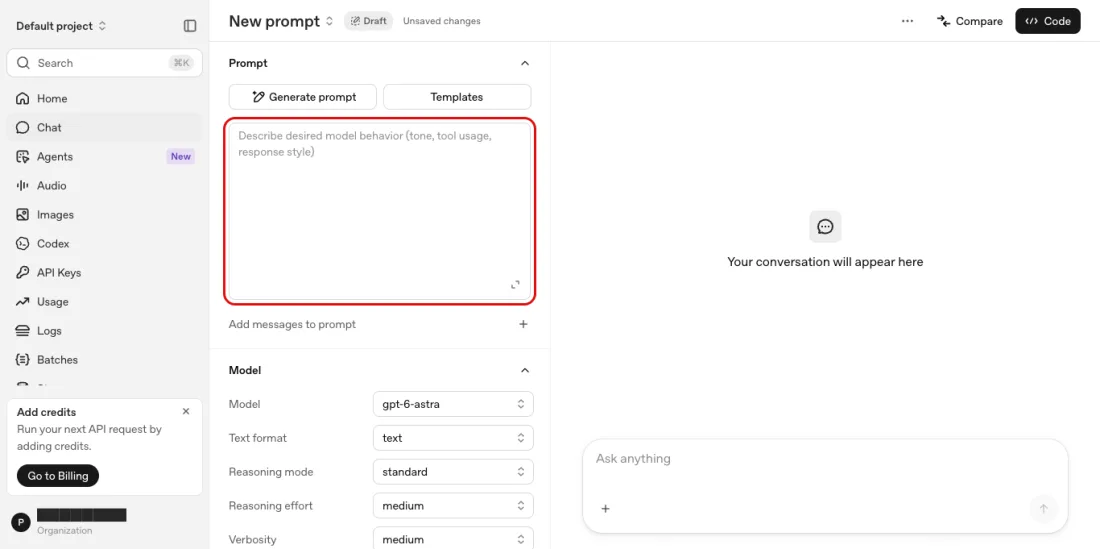
Describe desired model behavior (tone, tool usage, response style). Chat playground, the Prompt box where the brief goes as the instruction, above the Model settings, OpenAI API, screenshot taken 2026-09-16. Account details are masked.
Google AI Studio opens the Playground with a new chat prompt. Click Run settings in the top-right corner, paste the brief into System Instructions, type the topic in the message box and click Run; Get code turns the same prompt into API code when you are ready. Mistral Studio starts in Free mode without a card; under Build, Prompts, New prompt saves the brief as a versioned template you can test in the Playground and reuse for every piece for that client.
OpenAI: one request to /v1/responses with instructions (the brief) and input (the topic). Anthropic: one POST to /v1/messages with model, messages and max_tokens; the getting-started example sets max_tokens to 1000, and a 1,500-word draft is about 2,000 tokens, so raise it or the draft stops mid-sentence. Mistral: /v1/chat/completions with mistral-large-latest; a 402 means no payment method on the account.
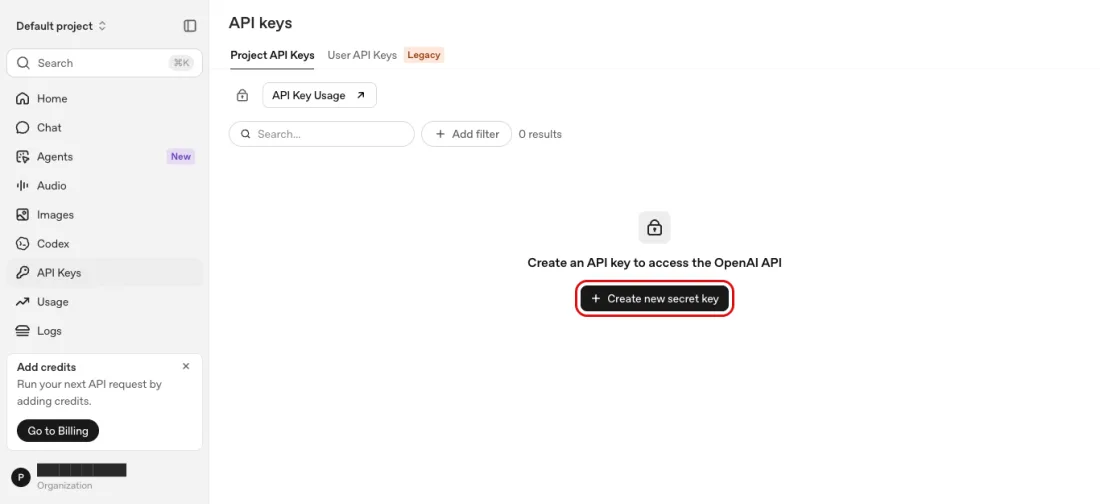
Create new secret key. API Keys page of a project, empty list, the button that makes the first key, OpenAI API, screenshot taken 2026-09-16. Account details are masked.
OpenAI's page says 100 tokens are approximately 75 words, so 1,500 words out is about 2,000 tokens and a 300-word brief in is about 400. Output is the column that matters: $0.60 per million on gpt-4o-mini makes the draft about a tenth of a cent; $50 on Claude Fable 5.1 makes it ten cents. The whole spread between the cheapest and dearest published model is under a dime per draft.
Anthropic's guide gives the sentence: Respond directly without preamble, do not start with phrases like Here is. It also says Claude Opus 5 defaults to longer answers and needs an explicit instruction to be concise. OpenAI's guide says to pin a dated model snapshot so the tone does not drift between pieces. Then do the pass no model does for you: the client's numbers, the names, the claims.
Anthropic's Message Batches API charges 50% of the standard price, finishes most batches in under an hour, expires anything unfinished at 24 hours and keeps results for 29 days. Mistral's pricing page says batch processing halves the price too. A month of a client's blog is one batch and half the bill.
OpenAI assigns the Output to the customer. Anthropic assigns its interest in Outputs to the customer and may not train on Customer Content. Read each provider's line before you sell a draft to a client who will ask.
Gemini's pricing page prints, under every model, that Free tier content is used to improve Google's products and Paid tier content is not. Anthropic's commercial terms say it may not train on Customer Content. If the brief contains anything the client gave you, the Free tier is the wrong door.
Anthropic deletes API inputs and outputs within 30 days. OpenAI deletes Customer Content within thirty days of termination and hands nothing back. The file you send the client is the only lasting copy.
instructions parameter gives the model high-level instructions on tone, goals and examples of correct responses and takes priority over the prompt in input.<example> tags, put long material such as the client's previous articles near the top of the prompt above the instructions, and for source-heavy pieces ask the model to quote the relevant parts before it writes.openai responses create --model "gpt-6-astra" --input "Write a one-sentence bedtime story about a unicorn." --raw-output --transform 'output.#(type=="message").content.0.text'
--instructions with the brief, put the topic in --input. Pin a dated model snapshot in production so the voice does not shift between pieces./v1/messages with model, max_tokens and a messages array; the system prompt holds the brief. The getting-started example sets max_tokens to 1000, and a 1,500-word draft is about 2,000 tokens, so leave it at 1000 and the article stops mid-sentence. The response reports input_tokens and output_tokens, so every call tells you what it cost./v1/chat/completions with mistral-large-latest. A 402 Payment Required means no payment method on the account, added under Admin, Subscriptions, Billing; a 429 means the Free mode rate limit, wait.FIG 1LOG SCALE
Output tokens are what a drafting job mostly buys. Log scale: the cheapest and the most expensive row on this list are 180 times apart, and a linear bar would flatten the first six rows into a hairline. Input prices are lower on every row and are in the facts.
The chart above is the output column as published, per million tokens: Together AI DeepSeek V4 Flash $0.28; OpenAI gpt-4o-mini $0.60, gpt-5.6-luna $1.20, gpt-5.6-sol $20.00 on promotional pricing through at least November 21, 2026; Mistral Large $1.5; Gemini 3.8 Flash $3.75 on the Paid tier until December 31, 2026 and $7.50 from January 1, 2027; Claude Haiku 4.5 $5, Sonnet 5 $10, Opus 5 $25, Fable 5.1 $50. Multiply by 2,000 tokens: a tenth of a cent on gpt-4o-mini, ten cents on Fable 5.1, with the 400 input tokens a fraction of that. The AI job cost calculator does it for any length; the Claude and OpenAI compare reads the two biggest lists side by side.
max_tokens above 2,000.Earns.io (2026). A 1,500-Word Draft Costs a Tenth of a Cent. The Three Hours It Saves Are Yours to Bill. Figures checked 2026-09-14. Retrieved from https://earns.io/en/methods/ai-drafting-by-the-token
https://earns.io/en/methods/ai-drafting-by-the-token
openai.com
GPT models billed per token.
This link pays this site nothing today. It goes to openai.com.
anthropic.com
Claude models billed per token. Production capacity you rent by the word.
This link pays this site nothing today. It goes to anthropic.com.
ai.google.dev
Google's model API with a free tier whose prompts are used to improve Google's products; paid usage is per million tokens and stays private.
This link pays this site nothing today. It goes to ai.google.dev.
mistral.ai
European model maker with a per-token API and open-weight models you can self-host under Apache 2.0 for research and individual use.
This link pays this site nothing today. It goes to mistral.ai.
together.ai
Serverless inference and GPU rental for open models, priced per million tokens or per GPU hour; you own your inputs and outputs.
This link pays this site nothing today. It goes to together.ai.
