The Model's Rent on 1,500 Words Is About a Cent. Measure It Once, Then Quote by the Word
What this is for
For anyone selling a service that runs on a language model and quoting by the word. You run one real job, read the usage line, and leave with a per-word cost at the published rates and a price above it, so every future quote has a floor.
What you make
A per-word price list for a service that runs on the API: one real job sent, its usage line read, the cost per word worked out at the published rates, a price set above it, and a folder holding every input and output because the providers keep none for you.
A writing or editing service that runs on a model pays rent by the token, and the rent is so small that the only mistake is not knowing the number. Both providers print it in the response to every call, so the way to price the service is not to read a rate card but to send one real job and read what comes back.
1,500 words delivered, about 2,000 output tokens
The rent
OpenAI gpt-4o-mini, $0.15 in and $0.60 out per million
about a tenth of a cent
Claude Haiku 4.5, $1 in and $5 out
about a cent
Claude Sonnet 5, $2 in and $10 out
about two cents
What the client pays for the same 1,500 words
a price in words, pages or hours that the rent cannot move
The per-word price you quote has the rent as one line and your time as the rest, and the rent will never move the total. What the measurement gives you is a floor you can prove, from a usage line you can show.
The play, in three lines
Send one job you actually sell through the API of Anthropic or OpenAI and write down the two numbers in the usage block, input_tokens and output_tokens.
Multiply by the published rates, divide by the words delivered, and write the per-word price list in the client's unit with that rent as one line inside it.
Save the job's input and output in your own folder, put a second provider's key beside them, and paste the ownership clause into your own client terms.
The path above walks every step. What follows is the reasoning behind each and the numbers you quote from.
Where the money comes from
The client, in their unit. A word count, a page, a piece, an hour. Nobody buys tokens.
Your time inside that price. Reading the result, checking the facts, making it sound like the client. Price it the way an editor prices it.
Not the provider. Anthropic sells prepaid credits with no published minimum; OpenAI bills per token from the first call with no plan fee. Neither charges anything to keep an account open.
The pain you are selling the cure for
The client wants the words back tomorrow, in their voice, checked, and does not want to learn a tool to get them. The service sells the tomorrow and the checking. On your side the pain is the quote: a per-word price guessed from a rate card is either too high to win or too low to survive, and the fix is one measured job.
The path, step by step
Every figure below is read from the platform profile it belongs to, not written into this page. Follow a name to see every answer we have for that platform.
1
Run one real job through the API and read the usage line
Anthropic's first-call example is one POST to /v1/messages with a model, max_tokens and the message; the response carries a usage block with input_tokens and output_tokens. OpenAI's Responses API takes instructions and input and bills per token from the first call with no plan fee. Send the job you actually sell, a 1,500-word edit or a 300-word product description, and write the two token counts down. That is the whole measurement.
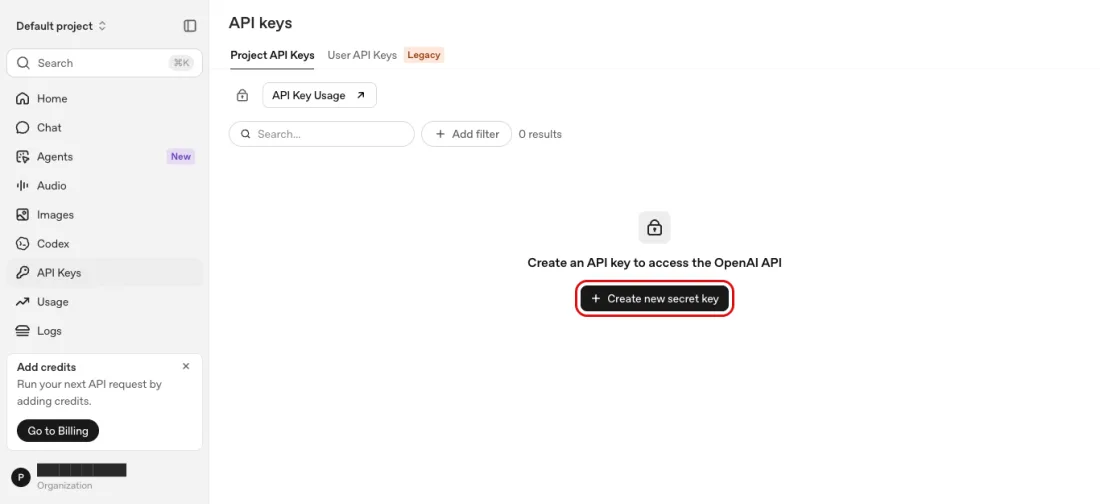
Outlined in red: Create new secret key. API Keys page of a project, empty list, the button that makes the first key, OpenAI API, screenshot taken 2026-09-16. Account details are masked.
Anthropic APIPrepaid credits, pay-as-you-go, no subscription. Cheapest entry rate is Haiku 4.5 at $1/MTok input and $5/MTok output; no minimum purchase is published.source · checked 2026-09-07
OpenAI APIBilled per token from the first call, no plan fee listed: gpt-4o-mini costs $0.15 per 1M input tokens and $0.60 per 1M output tokens.source · checked 2026-09-07
2
Convert the usage into a cost per word at the published rates
Multiply input tokens by the input price and output tokens by the output price, per million: Haiku 4.5 is $1 in and $5 out, Sonnet 5 $2 and $10 after its planned rise to $3 and $15 was cancelled, gpt-4o-mini $0.15 and $0.60. Divide by the words the job delivered. Two thousand output tokens on Haiku 4.5 is a cent; on Sonnet 5 two cents; on gpt-4o-mini a tenth of a cent. That is the rent per job, and it is smaller than the time you spend reading the result.
Anthropic APINo renewal fee, only per-token spend. Sonnet 5 holds at $2/MTok input and $10/MTok output after the scheduled rise to $3/$15 was cancelled.source · checked 2026-09-07
Set the price above the rent, in the unit your client understands
The client buys words, pages or hours, not tokens, so the price list is per word or per piece, with the model's cost as a line inside it that will not move the total. The article-cost page on this site puts the published human rates for the same work next to the token bill; the gap between them is your margin and your editing time.
4
Keep your own copy of every input and output from the first call
Anthropic auto-deletes API inputs and outputs within 30 days, so the only lasting copy is the one you store. OpenAI deletes all Customer Content from its systems within thirty days of the agreement terminating and hands nothing back. A service whose drafts live only in the console is paying twice for the same words the day it needs them.
Anthropic APINothing to port from Anthropic's side: API inputs and outputs are auto-deleted within 30 days, so the only lasting copy is the one you store yourself.source · checked 2026-09-07
OpenAI APINothing is handed back on the way out: when the agreement terminates OpenAI deletes all Customer Content from its systems within thirty days.source · checked 2026-09-07
5
Read who owns what the model writes
Both assign the output to you. Anthropic's commercial terms: the customer owns the Outputs and keeps all rights to Inputs, and Anthropic may not train models on Customer Content. OpenAI's services agreement: OpenAI assigns to the customer all of its right, title and interest in the Output. That clause is what lets you sell the words on.
Anthropic APICustomer owns the Outputs and keeps all rights to Inputs; Anthropic assigns its interest in Outputs and may not train models on Customer Content.source · checked 2026-09-07
OpenAI APIThe customer owns all Output - OpenAI assigns to the customer all of its right, title and interest in the Output, and the customer keeps ownership of its Input.source · checked 2026-09-07
6
Read what suspends you before you build a business on top
Anthropic may suspend all access over a suspected Usage Policy breach and disclaims liability for any loss of data or profits that causes. OpenAI may limit or suspend access if required by law or on a breach of the agreement or its policies, without prior notice where necessary. Neither account is assignable on its own without prior written consent. Keep the second provider's key in the same folder as the copies.
Anthropic APIAnthropic may suspend all access over a suspected Usage Policy breach, and disclaims liability for any loss of data or profits that suspension causes.source · checked 2026-09-07
OpenAI APIOpenAI may limit or suspend access if required by law or if the customer breaches the agreement or OpenAI Policies, without prior notice where necessary.source · checked 2026-09-07
Check these five before you sign up
1Send one real job and read usage: input_tokens and output_tokens in the Anthropic response; per-token billing from the first call at OpenAI.
2Convert to cost per word at the published rates: $1 and $5 per million on Haiku 4.5, $2 and $10 on Sonnet 5, $0.15 and $0.60 on gpt-4o-mini.
3Price per word or per piece, above the rent and the editing time; the client does not buy tokens.
4Store every prompt and draft yourself: Anthropic deletes within 30 days, OpenAI within thirty days of termination.
5Note that both assign the output to you, and that both can suspend over a suspected policy breach; keep a second key.
Step one: one real job, and the usage line
Anthropic's first call: a POST to /v1/messages with a model, max_tokens and a messages array. Near the bottom of the response is a usage block with input_tokens and output_tokens.
OpenAI's Responses API takes the same job as instructions and input and bills per token from the first call; pin a dated model snapshot for consistent behaviour.
Send the job you actually sell: an edit of a 1,500-word draft, twenty product descriptions, a transcript summary. Three real inputs, three usage lines, and the numbers are close enough to price on.
Step two: tokens to cents to words
Haiku 4.5: $1 per million input tokens and $5 per million output. Sonnet 5: $2 and $10, after the scheduled rise to $3 and $15 was cancelled. gpt-4o-mini: $0.15 and $0.60.
Input tokens times the input price, output tokens times the output price, both per million, divided by the words delivered.
The price list is in words, pages, hours or pieces, and the model's rent is one line inside each that will not move the total.
What moves the total is your time. The drafting guide shows how to write the brief once so the reading time falls with every job.
Step four: the folder
Anthropic's privacy centre: API inputs and outputs are automatically deleted within 30 days. The only lasting copy is the one you store.
OpenAI's services agreement: on termination OpenAI deletes all Customer Content within thirty days and hands nothing back.
A service whose drafts live only in a console pays twice for the same words on the day it needs them, and loses the record of what the client approved.
Who owns what the model writes
Anthropic: the customer owns the Outputs and keeps all rights to Inputs; Anthropic assigns its interest in Outputs and may not train models on Customer Content.
OpenAI: the customer owns all Output; OpenAI assigns to the customer all of its right, title and interest in it; the customer keeps ownership of its Input.
That clause is what lets you sell the words on. Put it in your own client terms in the same words.
What ends it
Anthropic may suspend all access over a suspected Usage Policy breach and disclaims liability for any loss of data or profits that causes.
OpenAI may limit or suspend access if required by law or if the customer breaches the agreement or OpenAI Policies, without prior notice where necessary.
Neither account is sellable on its own: Anthropic's contract needs its prior written consent to assign, and OpenAI's is not assignable except to a successor of substantially all the business.
The folder from step four plus a second provider's key means a suspension is an afternoon, not a business. The client-data page reads what each keeps of the conversations.
What to do today
Send one job you already sell through the API and read the usage block.
Multiply by the published rates and divide by the words.
Write the per-word price list with that rent as one line, save the input and output to a folder, and put the second provider's key beside them.
Earns.io (2026). The Model's Rent on 1,500 Words Is About a Cent. Measure It Once, Then Quote by the Word. Figures checked 2026-09-14. Retrieved from https://earns.io/en/methods/renting-ai-by-the-word