A $20 File Pays You $19 at Payhip and $7 at Amazon. List It Where the Money Stays Yours
What this is for
For anyone selling a $20 file who wants to know how much of it survives the platform's fee. You get the file live where $19 stays yours, priced inside the band the fee table rewards, with the buyer list exportable and the date the money is spendable.
What you make
Your file live on the platform that leaves you the most of $20, with the price set where the platform's fee table rewards it, the buyer list exportable, and a note of the day the first sale becomes money you can spend.
The buyer pays $20 in all four places. What comes back to you is decided by which page you listed on and, in one case, what number you typed in the price box.
Where the $20 file is listed
What the platform keeps
What is left of $20
Payhip, Free Forever plan
5% per transaction, plus your processor's own fee
$19.00
Lemon Squeezy
5% + 50c per transaction
$18.50
Gumroad, through your own link
10% + $0.50 per transaction
$17.50
Gumroad, found through Discover
30% per transaction
$14.00
Amazon KDP, ebook listed at $20
65%, because $20 is outside the 70% band
$7.00
The spread is $12.00 on a $20 sale, before a single word of marketing. And the store that keeps the most is also the one with no payout cycle at all: Payhip sends the buyer's money to your own PayPal or Stripe at the time of purchase. The play is to put the file where $19 stays yours, price it where the fee table rewards it, and keep the buyer list on your own disk so the store is never the only copy.
The play, in three lines
Connect PayPal or Stripe on Payhip first, then upload the file, set the price, make it Visible: $19.00 of every $20, arriving with the sale.
If the same file is a book, list it on Amazon KDP too, priced at $12.99 or under so it earns 70% instead of 35%.
Export the customer list on the day of the first sale and on the first of every month, because two of the four stores keep the list when the account goes.
The path above walks every click. What follows is the reasoning behind each step and the numbers you quote from.
Where the money comes from
Your own audience, through your own link. The cheapest buyer there is: 5% at Payhip, 5% + 50c at Lemon Squeezy, 10% + $0.50 at Gumroad. Every reader you send to your own page is a sale at the low rate.
Gumroad's Discover marketplace. A stranger who finds you inside Gumroad costs 30%, three times the rate on a buyer you brought yourself. Useful for the first sales, expensive as a habit.
Amazon readers. The biggest pool and the least of it comes back: 35% at $20, 70% only inside the $2.99 to $12.99 band, and Amazon owns all customer data, so none of them become your list.
The pain you are selling the cure for
The buyer wants the file now, on the device in their hand, paid for in one click with a card they already use, and a download that does not break. They do not care which store it sits on. Every one of the four handles that. What they cannot see is the fee table behind the buy button, and that table is where a $20 file quietly becomes $7. Nobody who sells files for a living argues about it; they read it once and list accordingly.
The path, step by step
Every figure below is read from the platform profile it belongs to, not written into this page. Follow a name to see every answer we have for that platform.
1
Work the $20 through each fee table before you pick a store
Payhip's Free Forever plan takes 5%: $19.00 left, before your own PayPal or Stripe fee, which Payhip does not cover. Lemon Squeezy takes 5% + 50c: $18.50, with 1.5% more for international cards or PayPal. Gumroad takes 10% + $0.50 through your own link: $17.50; through its Discover marketplace 30%: $14.00. Amazon KDP pays 35% on an ebook listed at $20, because the 70% option stops at $12.99: $7.00. The chart above is this step.
PAPayhipFree Forever plan: $0 a month, all features and unlimited products, but Payhip charges a 5% fee on every transaction.source · checked 2026-09-07
Lemon SqueezyFree to open a store: $0/month, no card and no contract required. The only entry cost is the 5% + 50c fee taken per transaction.source · checked 2026-09-07
GumroadNo signup or subscription cost to start selling; Gumroad's cut is 10% + $0.50 per transaction on sales through your own profile or links.source · checked 2026-09-07
KDPAmazon KDPFree to use: no upfront or listing fee to publish an eBook or print book, and print copies are produced on demand.source · checked 2026-09-07
2
Put the file on the store that keeps the most, and connect your processor first
On Payhip, connect PayPal or Stripe under Account, Settings, Payment Details, then Products, Add new product, Digital Product: upload the file (up to 5GB), title, price, cover, description, and publish as Visible. The money goes to your processor at the time of purchase, so there is no payout cycle. The digital-files guide on this site walks the same screens for sellers PayPal and Stripe skip.
3
If the file is an ebook for Amazon, price it inside the 70% band or accept 35%
KDP's 70% royalty option is available only at a list price of $2.99 to $12.99 on Amazon.com, widened from $9.99 on 7 July 2026, and only for buyers in certain territories, with Brazil, Japan, Mexico and India also requiring KDP Select. A $20 ebook is legal to list, from $0.99 up to $200.00, and pays 35%. Delivery costs on the 70% option average $0.06 a unit. So either the price moves to $12.99 and pays about $9, or it stays at $20 and pays $7.
4
Set the price above the floor you have to reach
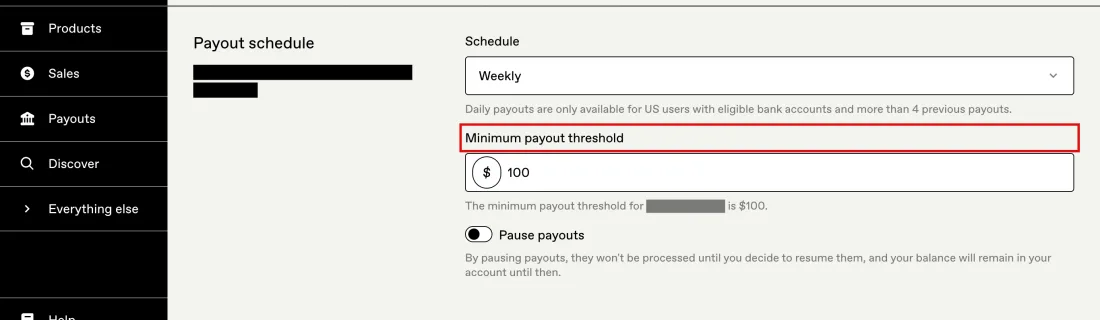
Lemon Squeezy releases money at $50; below it the balance stays Pending. Gumroad needs a $100 balance, higher in a long list of countries. KDP has no minimum on direct deposit, and 100 USD or 100 EUR for wire or cheque, wire only in Japan at 10,000 JPY. Payhip has no floor because it holds nothing. Three $20 sales clear Lemon Squeezy; five clear Gumroad.
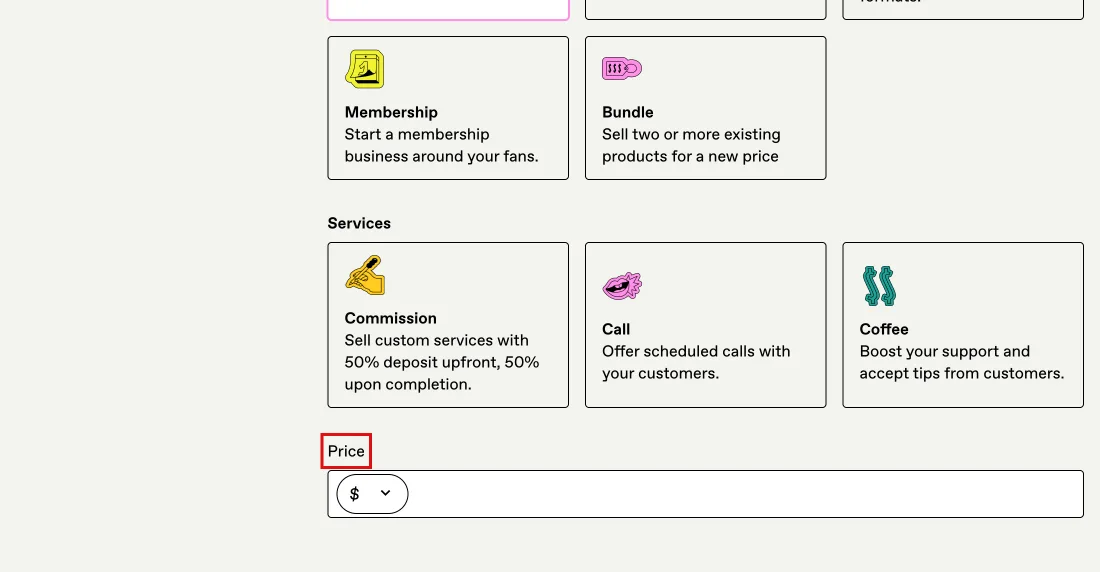
Outlined in red: Price. Products, New product: the product-type tiles and the Price field at the bottom of the form, Gumroad, screenshot taken 2026-09-16. Account details are masked.
Lemon Squeezy$50 minimum payout threshold. Below it the balance stays Pending and rolls into the next payout cycle.source · checked 2026-09-07
KDPAmazon KDPNo minimum on direct deposit. Wire and cheque both need 100 USD on Amazon.com and 100 EUR in the EU; Japan is wire only, at 10,000 JPY, with cheque not available there at all.source · checked 2026-09-07
Gumroad$100 USD balance, with higher local minimums in a long list of countriessource · checked 2026-09-08
5
Put the payout day in the calendar
Payhip: at purchase. Lemon Squeezy: net sales held 13 days, released on the 14th and 28th, then 1 to 5 days to the bank. Gumroad: no fixed schedule in the terms, weekly in practice after a 7-day hold, and above a 15% refund rate it reserves 25% of pending funds for 90 days. KDP: monthly, roughly 60 days after the close of the sale month, 90 for Expanded Distribution.
Outlined in red: Minimum payout threshold. Settings, Payments, the Payout schedule block: Weekly, the minimum payout threshold for your country, and Pause payouts, Gumroad, screenshot taken 2026-09-16. Account details are masked.
PAPayhipMoney is sent to the seller's own connected payment processor at the time of purchase, so there is no monthly Payhip payout cycle.source · checked 2026-09-07
Lemon SqueezyNet sales are held 13 days, released on the 14th and 28th of the month, then 1-5 days more to land in the bank.source · checked 2026-09-07
GumroadNo fixed payout schedule in the terms; above a 15% refund rate Gumroad reserves 25% of a seller's pending funds for 90 days on a rolling basis.source · checked 2026-09-07
KDPAmazon KDPPaid monthly, roughly 60 days after the close of the sale month, and 90 days for Expanded Distribution.source · checked 2026-09-07
6
Export the buyer list on the day of the first sale, and repeat
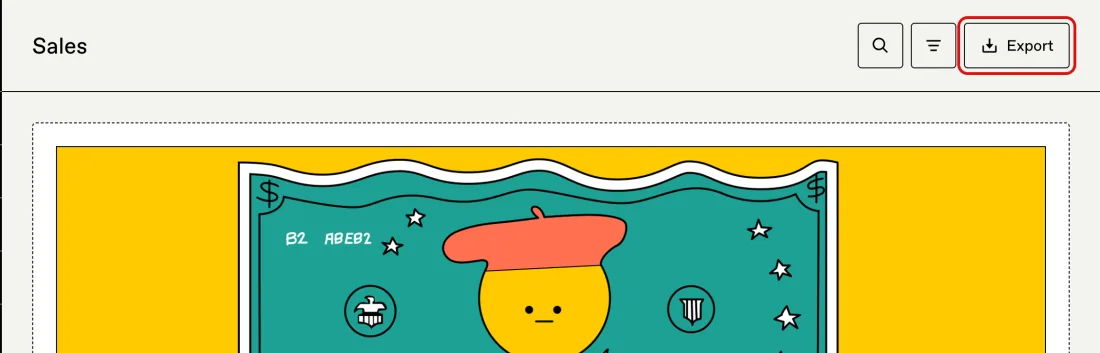
Payhip exports the full customer list to CSV with one Export button in the admin dashboard, and Gumroad has the same button at the top right of its Sales page. Lemon Squeezy's export window closes with the account: after termination there is no access to the service or the data in it. Amazon owns all KDP customer data; no reader list travels, though the manuscript can be sold elsewhere under a nonexclusive licence. Export monthly and keep the file.
Outlined in red: Export. Sales page, top right, next to search and filter, Gumroad, screenshot taken 2026-09-16. Account details are masked.
PAPayhipThe full customer list exports to CSV from the admin dashboard with one Export button.source · checked 2026-09-07
Lemon SqueezyThe export window closes with the account: after termination there is no access to the service or the data stored in it.source · checked 2026-09-07
KDPAmazon KDPThe manuscript can be sold elsewhere under a nonexclusive licence, but no reader list travels: Amazon owns all customer data.source · checked 2026-09-07
7
Read the paragraph that ends the account before you depend on it
Payhip may permanently delete an account for banned content without notice. Lemon Squeezy's store, checkout, customer list and payouts sit with one entity, now trading as Link, LLC. Gumroad may halt sales and suspend or terminate at any time, in its sole discretion, without cause or notice. Amazon may terminate or suspend KDP at any time if it has concerns, and termination for breach forfeits unpaid royalties.
PAPayhipSelling banned content risks the Payhip account being permanently deleted without prior notice.source · checked 2026-09-07
Lemon SqueezySingle-vendor dependency: store, checkout, customer list and payouts all sit with one entity, now trading as Link, LLC, formerly Lemon Squeezy LLC.source · checked 2026-09-07
GumroadGumroad may halt sales and suspend or terminate an account at any time, in its sole discretion, without cause or notice.source · checked 2026-09-07
KDPAmazon KDPAmazon may terminate or suspend the account at any time if it has concerns with it; termination for breach forfeits unpaid royalties.source · checked 2026-09-07
Check these five before you sign up
1Work the $20 through every table first: $19.00 Payhip before your processor, $18.50 Lemon Squeezy, $17.50 Gumroad own link, $14.00 Gumroad Discover, $7.00 Amazon KDP at $20.
2Connect your processor before the product page on Payhip; the money lands there at purchase and there is no payout cycle.
3On KDP, either price at $2.99 to $12.99 for 70% or accept 35% at $20; the band widened from $9.99 on 7 July 2026.
4Price so a handful of sales clears the floor: $50 at Lemon Squeezy, $100 at Gumroad, none at Payhip or KDP direct deposit.
5Put the payout day in the calendar: purchase day, the 14th or 28th, weekly after 7 days, or about 60 days after the month.
6Export the customer list on the first sale and every month after; Lemon Squeezy's export ends with the account and Amazon keeps all reader data.
Step one: the $20 through each table
Payhip's Free Forever plan: $0 a month, all features, unlimited products, 5% on every transaction; the billing page says plainly that PayPal and Stripe still charge their own fees on top. Plus at $29 a month cuts the fee to 2%; Pro at $99 removes it.
Lemon Squeezy: free to open, no card, no contract; 5% + 50c per sale, plus 1.5% for international cards, 1.5% for PayPal, 0.5% for subscriptions.
Gumroad: no monthly fee; 10% + $0.50 through your own profile or links; 30% when a new customer finds you through Discover.
Amazon KDP: free to publish, no listing fee, and 35% on an ebook listed at $20.
The first chart above is this list as shares of the price: 95%, 92.5%, 87.5%, 70%, 35%.
Step two: the store, with the processor first
On Payhip: Account, Settings, Payment Details, link PayPal or Stripe. Then Products, Add new product, Digital Product: upload with the Upload product file button, each file up to 5GB; title, price, cover image, description; Visible. A plus after the price, 5+, sets pay-what-you-want with a floor.
The buyer's money goes to your processor at the time of purchase. There is nothing to wait for and nothing for Payhip to hold.
Gumroad's page is the same shape: New product on the Products dashboard, a type, a price from free to USD 5,000 with the same plus, files and pages on the Content tab, publish.
PayPal and Stripe do not receive in your country: the digital-files guide connects one of Payhip's other processors on the same screen.
FIG 1%
What is left of one $20 sale, as a share of the price
Same file, same price, five places to list it. The gap between the top and the bottom line is 60 cents in every dollar.
The 70% royalty option is available only at a list price of $2.99 to $12.99 on Amazon.com, a band widened from $2.99 to $9.99 on 7 July 2026, and only on purchases by customers in certain territories; for Brazil, Japan, Mexico and India the book must also be enrolled in KDP Select.
Outside the band the only rate offered is 35%. The 35% option runs from $0.99 for a file under 3 megabytes up to a $200.00 maximum, so a $20 ebook is perfectly legal to list and pays $7.00.
Delivery costs on the 70% option are charged per sale, averaging $0.06 a unit, and vary with file size.
The decision is a price. At $12.99 the same book pays about $9 after delivery; at $20 it pays $7 and looks more expensive. Type the number knowing which side of $12.99 it is on.
The floor you have to reach
Payhip holds nothing, so there is no floor.
Lemon Squeezy releases money at a $50 minimum; below it the balance stays Pending and rolls into the next cycle. Three $20 sales.
Gumroad needs a $100 USD balance, with higher local minimums in a long list of countries. Five sales.
KDP has no minimum on direct deposit; wire and cheque both need 100 USD on Amazon.com or 100 EUR in the EU; Japan is wire only at 10,000 JPY with no cheque at all.
The days between the sale and the money
Payhip: the same day, because the buyer paid your processor.
Lemon Squeezy: net sales are held 13 days and released on the 14th and 28th of the month, then 1 to 5 days more to reach the bank.
Gumroad: no fixed payout schedule in the terms; above a 15% refund rate it reserves 25% of a seller's pending funds for 90 days on a rolling basis.
KDP: monthly, roughly 60 days after the close of the sale month, and 90 days for Expanded Distribution.
FIG 2days
Days between the sale and the money being yours
Two of these are payout schedules. The Gumroad line is not a schedule at all, it is a reserve that switches on when refunds climb.
The second chart above lines up the days; this is the list. Payhip exports the full customer list to CSV from the admin dashboard with one Export button, and connecting your own domain is optional, not required. Lemon Squeezy's export window closes with the account: after termination there is no access to the service or the data stored in it, and store, checkout, customer list and payouts all sit with one entity, now trading as Link, LLC. On KDP the manuscript can be sold elsewhere under a nonexclusive licence, but no reader list travels, because Amazon owns all customer data. The habit that fixes all three: export on the day of the first sale, and on the first of every month after, to a folder that is not the platform.
What ends it
Payhip: selling banned content risks the account being permanently deleted without prior notice.
Lemon Squeezy: one vendor holds everything, and the export ends when the account does.
Gumroad: it may halt sales and suspend or terminate an account at any time, in its sole discretion, without cause or notice.
KDP: Amazon may terminate or suspend the account at any time if it has concerns with it, and termination for breach forfeits unpaid royalties.
None of these is a reason not to list. All of them are the reason the list lives on your disk and the file lives in more than one store.
What to do today
Run the table above on your actual price.
Connect PayPal or Stripe on Payhip, upload the file, make it Visible.
If it is a book, decide which side of $12.99 it lives on before you open KDP.
Export the customer list the first time it has a name in it.
Earns.io (2026). A $20 File Pays You $19 at Payhip and $7 at Amazon. List It Where the Money Stays Yours. Figures checked 2026-09-14. Retrieved from https://earns.io/en/methods/what-you-keep-when-you-sell-a-digital-file